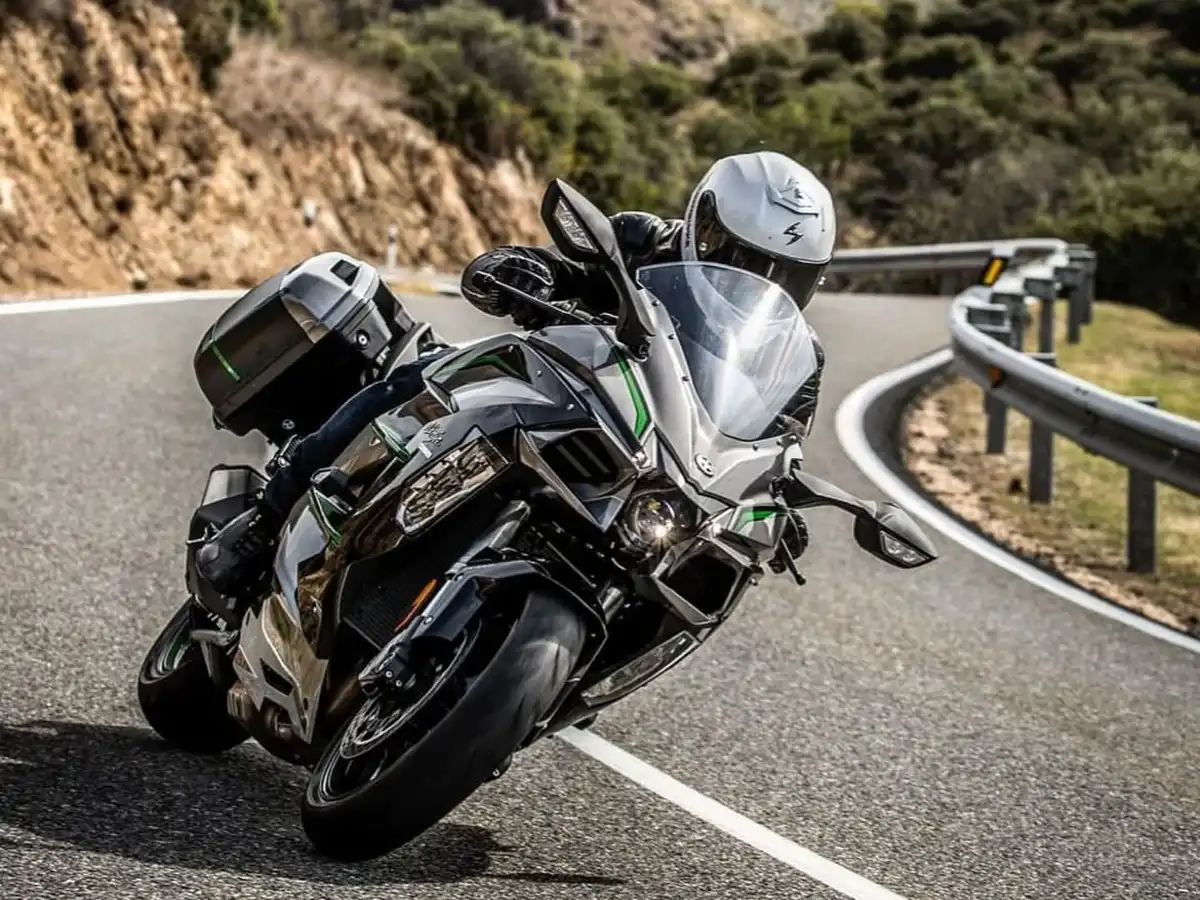
Quick Answer : 2027 Kawasaki Ninja H2 has been certified by the EPA and CARB at 197 hp at 10,500 rpm, down from 228 hp at 11,500 rpm on the outgoing model — a 31-hp cut that aligns the supercharged flagship with the naked Z H2 SE’s engine tune. The change is driven by tightened emissions rules, and it appears designed to let Kawasaki bring the H2 back to Europe, where it was pulled from sale after Euro5 took effect.
Kawasaki’s Ninja H2 is losing its signature power advantage as the supercharged superbike returns for the 2027 model year with a significantly detuned engine. Homologation paperwork filed with the U.S. Environmental Protection Agency and California’s Air Resources Board shows the flagship now shares its certification with the Z H2 SE, rather than carrying its own standalone rating as it has every year since 2015.
What Changed Under the Fairing
The numbers are the story here. The outgoing 2026 Ninja H2 and H2 Carbon were certified at 228 hp at 11,500 rpm. The 2027 filings list a peak of 197 hp at 10,500 rpm — identical to the Z H2 SE’s naturally-tamer state of tune.
That figure isn’t arbitrary. It’s the exact output the original 2015 Ninja H2 launched with, before Kawasaki pushed it to 202 hp in 2017 and then 228 hp in 2019. A decade of development has, on paper, come full circle.
CARB filings point to the mechanism: the 2027 H2 adopts the Z H2 SE’s exhaust system, which adds a second catalytic converter. A tighter exhaust path is a common way to bring a high-output engine into compliance without a full redesign, and it typically costs both peak power and top-end rev range.
Why Kawasaki Is Doing This Now
Global emissions timing is central to this. Euro5 rules pushed the full-power H2 out of European showrooms years ago, while markets like the US and Australia kept selling the 228-hp version. The Z H2 SE’s lower-output engine is already certified to the stricter Euro5+ standard.
Model-code changes support the idea that this is more than a simple retune. Australian homologation records list new codes — ZXT02W for the Ninja H2 and ZXT02X for the H2 Carbon — replacing the current ZXT02J designation, which typically signals a new generation rather than a mid-cycle tweak.
Riders in the US, Australia, and Asia-Pacific should expect to see the revised H2 first, given those are the markets currently selling the full-power version. European availability, if it materializes, would represent a genuine reintroduction after a multi-year absence tied directly to the compliance work behind this update.
ORIGINAL ANGLE: A Forced Strategy Pivot, Not a Simple Retune
This is less an engineering setback than a calculated trade of peak-number bragging rights for market reach. The H2’s entire identity was built on being the horsepower outlier — the one production bike that could out-muscle naturally aspirated rivals without a paddock pass. Slotting it under 200 hp erases that gap on paper, but it also unlocks a market Kawasaki has been shut out of since Euro5. For a model whose sales volume was likely modest even at its peak, trading a marketing flex for renewed access to Europe’s much larger sportbike-buying base is a defensible business call, even if it stings for loyalists. The bigger risk is competitive positioning: rivals from Ducati, Aprilia, BMW, and Honda have all climbed past 210 hp through refinement rather than forced induction, so Kawasaki’s supercharger — once an unanswerable trump card — no longer guarantees a spec-sheet win. Expect Kawasaki to lean harder on the H2’s mechanical character, soundtrack, and low-end torque delivery rather than peak-number supremacy in how it markets the revised bike.
What’s Still Unknown
The EPA and CARB filings only cover emissions-relevant data. They say nothing about chassis changes, electronics updates, or styling revisions, so it’s unclear whether the “new generation” model codes reflect a broader refresh beyond the engine and exhaust.
The track-only Ninja H2R, which isn’t road-legal, appears unaffected. Since it isn’t subject to the same emissions requirements, Kawasaki retains full flexibility to keep the H2R at its current 322-hp rating.
One wrinkle: UK buyers may never see this update at all. Kawasaki reportedly stopped taking new orders for the road-going H2 and H2 Carbon in the UK last year, making the 2026 model the final edition sold there — meaning these US filings could remain largely academic for British riders regardless of what happens elsewhere.
Global Spec Comparison
| Spec | 2026 Ninja H2 | 2027 Ninja H2 (filed) | Aprilia RSV4 1100 | Ducati Panigale V4 | BMW S 1000 RR |
|---|---|---|---|---|---|
| Price (est.) | ~$29,000 / ~€31,000 | TBD | ~$27,000 / ~€25,600 | ~$29,000 / ~€27,800 | ~$21,000 / ~€20,700 |
| Peak Power | 228 hp @ 11,500 rpm | 197 hp @ 10,500 rpm | 220 hp | 213 hp | 210 hp |
| Engine | 998cc supercharged inline-4 | 998cc supercharged inline-4 (Z H2 SE tune) | 1099cc V4 | 1103cc V4 | 999cc inline-4 |
| Top Speed | ~186 mph / 299 km/h | TBD | ~185 mph / 298 km/h | ~187 mph / 300 km/h | ~188 mph / 303 km/h |
| Primary Competitors | Aprilia RSV4, Ducati Panigale V4, BMW S 1000 RR, Honda CBR1000RR-R | — | — | — | — |
Pricing and top-speed figures for the 2027 H2 are not yet published; comparison-model prices are approximate MY2025/2026 US/EU street pricing.

Dhanush H M is a passionate automotive journalist, rider, and tech analyst specializing in global motorcycle developments, electric mobility (e-2W), and two-wheeler engineering. At Motospoke.com, Dhanush leads coverage on major global launches, motorcycle safety technology, performance specs, and EV battery advancements across North American, European, and Asian markets.
With years of track, road, and technical testing experience, Dhanush focuses on stripping away marketing hype to deliver honest, data-backed insights for everyday commuters, adventure riders, and track enthusiasts alike.
